Discovery & Requirements Gathering
The project began with a series of structured stakeholder meetings to align on
goals, expectations, and long-term vision. To make requirement collection more organized across multiple
stakeholders, I designed and distributed a Google Form survey that helped gather inputs consistently
before moving into design.
This phase helped the team build a shared understanding of the platform’s challenges, priorities, and
opportunities early on.
Requirement Survey
Questions and structure for systematic requirements collection across stakeholder groups
Early project documentation in Notion
Requirements synthesis, reference mapping, and competitive research compiled before any design
work began.
2
Structuring the System
Once the requirements were finalized, I translated them into a clear product structure and user
experience strategy. I created detailed information architecture maps and mind maps to organize complex
modules such as news, opportunities, events, and CMS workflows.
To ensure the platform was grounded in real user behavior, I developed user personas and mapped key user
flows before moving into wireframing. These early wireframes became an important collaboration tool
between design, stakeholders, and development teams allowing us to validate logic and interactions
before investing in high-fidelity UI.
Mindmap
Deck used for kickoff and alignment conversations
Wireframe
Questions and structure for systematic requirements collection across stakeholder groups
3
Project Planning
I built a detailed Gantt chart spanning 8 milestones which gave stakeholders clear visibility into
progress and dependencies throughout
the engagement. For day-to-day team execution, I ran task management through a Trello board structured
by milestone, with separate lanes for frontend, backend, and UI work. The Gantt kept the client
aligned on delivery; Trello kept the team unblocked.
This planning framework helped the entire team stay aligned while giving stakeholders clear visibility
into progress, dependencies, and delivery expectations throughout the engagement.
Gantt Chart and Trello
Outline of milestones across discovery, design, development, QA, UAT, and final handoff
4
UI Design & Iterative Refinement
UI Design was developed iteratively through multiple structured revision rounds with
stakeholders. Every revision round focused on refining usability, improving clarity, and aligning the
platform with both user needs and organizational goals.
To maintain transparency and
accountability, I documented each discussion through structured Meeting Minutes (MoMs), capturing
feedback, decisions, requested changes, and agreed next steps after every session.
This process helped reduce ambiguity, improved collaboration, and ensured everyone remained aligned
throughout the project lifecycle.
5
Team Coordination & Parallel Development
The project required close collaboration between frontend and backend teams working in parallel across
multiple modules. I coordinated communication between teams, managed design-to-development handoffs,
clarified requirements, and proactively resolved blockers to keep delivery moving efficiently.
By maintaining regular syncs and establishing clear workflows, we were able to accelerate development
without compromising necessary features, quality or consistency across the platform.
6
Managing Stakeholders & Evolving Requirements
One of the most challenging aspects of the engagement was balancing ambitious stakeholder expectations
with evolving requirements, tight delivery expectations, and limited budget flexibility.
To navigate this effectively, I introduced structured change tracking, documented key decisions
throughout the project, and established clear communication processes to create alignment between
stakeholders and the delivery team.
By combining transparent communication with evidence-based decision making, I helped maintain trust,
manage scope responsibly, and keep the project focused on delivering a stable, user-friendly system
ready for UAT with minimal defects.
7
Final Handoff & Project Closure
The final phase focused on ensuring a smooth transition for the client team after launch. I prepared
and delivered comprehensive project closure materials, including:
- Project Closure Report
- Handoff Presentation
- User guide for non-technical administrators
- Platform user guide for end users
This helped ensure the client could confidently manage, maintain, and operate the platform independently
after delivery.
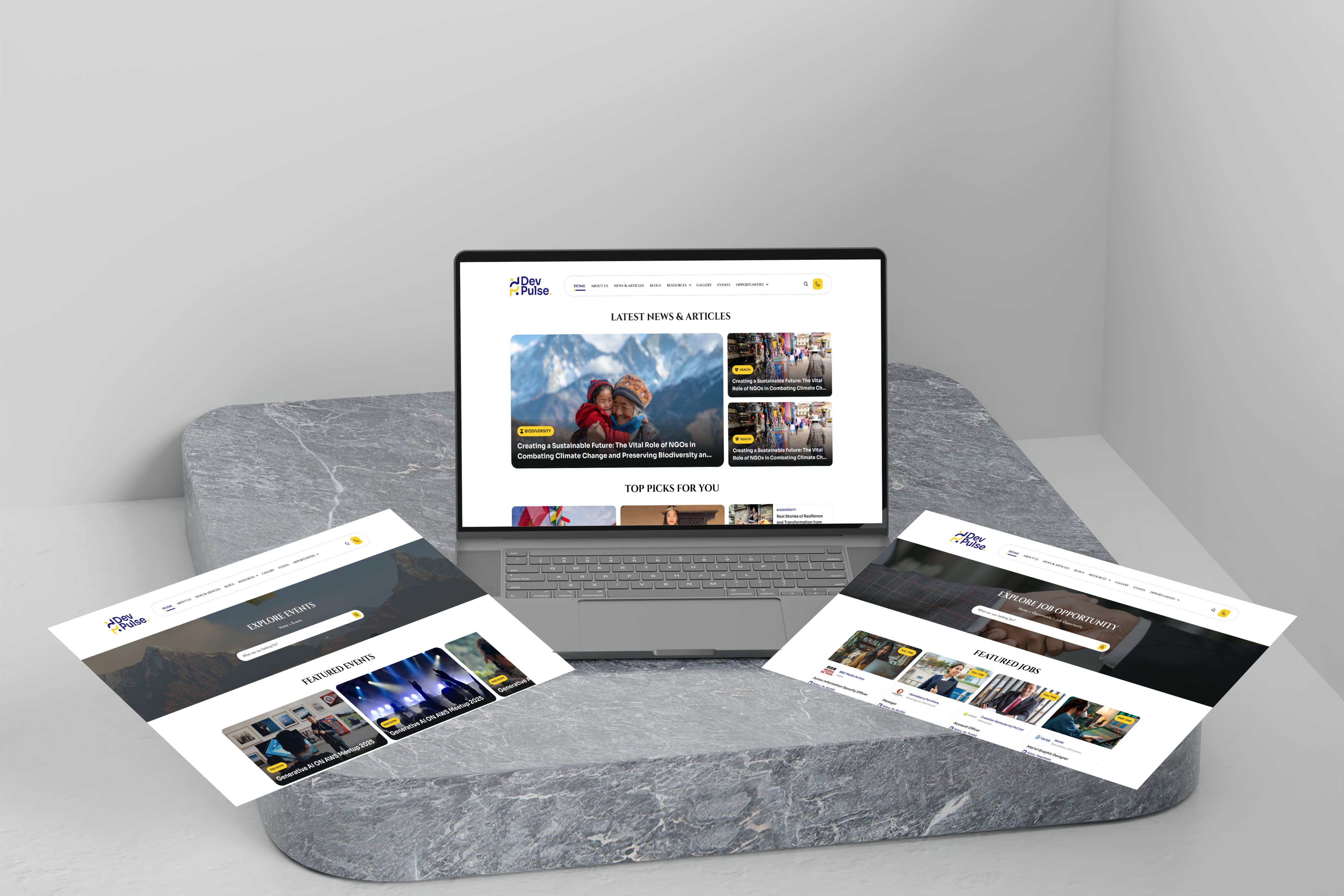
Platform
What we built
Development Pulse launched as three integrated modules backed by a custom CMS — each
designed to address a specific gap in the sector's information ecosystem.
Integrated Opportunities Portal
Unified listings for jobs, RFPs, and grants with sector-specific filtering and streamlined application
workflows.
Custom CMS with WYSIWYG Editor
Designed for non-technical NGO staff — visual editing with real-time preview, SEO tagging, metadata, and
scheduled publishing.
Event Management System
Event listings with agenda support, map-based location integration, and improved discoverability across
the sector.
Content Recovery System
30-day content rollback feature to prevent accidental data loss — critical for a team of non-technical
administrators.
Sector-Specific Navigation
Content categorized by development focus areas — Climate Change, Disaster Management, Biodiversity —
improving relevance and discovery.
Multimedia Publishing
Support for articles, PDFs, infographics, and audio content — enabling organizations to share diverse
formats of impact reporting.
Challenges
What made this difficult and how I handled it
Evolving requirements throughout delivery
Scope changes were a recurring theme. I responded by introducing formal change tracking every new request
was logged, assessed for impact, and discussed explicitly rather than absorbed silently. This created a
shared understanding of trade-offs and helped prevent uncontrolled scope expansion without alienating the
client.
High expectations vs. real-world constraints
The engagement required balancing an ambitious product vision against a fixed budget and timeline. Rather
than overpromising, I prioritized core functionality and system stability, and used documented evidence —
timelines, change logs, UAT traceability matrices — to facilitate honest, grounded conversations about what
was achievable within the given parameters.
UAT quality standards
The client had a firm expectation of a functionally clean system at UAT. To meet this, I built a rigorous
QA process — systematic testing cycles, detailed defect logs, and a UAT traceability matrix that mapped
every test case to its outcome. This structure ensured nothing was missed and made the QA process
transparent to all stakeholders.
Cross-functional team coordination
Managing design and development in parallel — across a full team — required proactive communication, clear
ownership of deliverables, and consistent documentation. Meeting Minutes after every session ensured
alignment was preserved between touchpoints and that no decision was left ambiguous.
Impact
What the platform delivered
Development Pulse launched as the first centralized digital hub for Nepal's development
sector. Across all three modules, the platform delivered measurable improvements to how professionals access
information, discover opportunities, and engage with sector events.
For administrators, a purpose-built CMS reduced the friction of content publishing from
a technical task to a routine one. For organizations, the platform provided a credible, visible channel to
communicate their work. For the sector as a whole, it replaced a fragmented, multi-platform experience with a
single, reliable destination.
The project was delivered on time with full documentation, a clean UAT outcome, and a handoff package that
empowered the client's team to operate the platform independently.
Reflections
What I took away
- Strong, consistent documentation is not just process overhead in high-friction environments, it is the
single most effective tool for protecting both delivery and relationships.
- Designing for non-technical users requires a different kind of discipline: every added option, every
unfamiliar term, every extra step is a potential failure point.
- Stakeholder alignment at the outset including explicit agreement on scope, change process, and
decision-making hierarchy is worth far more time investment than it costs.
- Balancing product quality against real constraints is not a compromise it is the core skill of product
leadership.
- A thorough handoff is not the end of a project it's the last thing a client remembers, and it sets the
tone for how the work is perceived long after delivery.
What I'd do differently
I'd establish a clear stakeholder decision-making hierarchy at kick-off to reduce
ambiguity
during revision rounds and push for a phased delivery model launching core features first and layering
additional functionality rather than a single full-scale release. I'd also allocate dedicated time post-launch
for analytics, iteration, and product refinement.